Found this cool infographic online. What are you made of?
Monday, August 19, 2013

Tuesday, May 21, 2013
Tuesday, May 14, 2013
Thursday, April 25, 2013
Wringing out a Washcloth in Space!
Just felt like sharing this with you guys.
Before watching, try to guess what will happen.
Got it? Let's watch.
Why doesn't this work on Earth?
Before watching, try to guess what will happen.
Got it? Let's watch.
Why doesn't this work on Earth?
Tuesday, March 26, 2013
Quarter 4 Extra Credit
This one is multi part. I recommend you start now.

- Choose one of the Grand Challenges of Engineering.
- Write a paragraph on each of the following:
- What is it?
- Why is it important?
- Why is it difficult?
- Who are some people working on it?
- Email or phone interview with someone working on or with knowledge of the project
- 10 questions
- Clear this with me first.
- What is your solution?
- At least 500 words
- Be specific

Thursday, March 21, 2013
Scale of the Universe
As requested by some, here is the Scale of the Universe site. It makes you feel very small (or big, if you go the other way).
Tuesday, March 5, 2013
The End of Antibiotics?
In the A&P classes, we have been talking about antibiotic resistance in bacteria. Here's an article highlighting the problem in American hospitals. Some bacteria are virtually resistant to every antibiotic that is on the market.
 Why not just make new ones? The process for bringing a new drug to market takes many years and much money. It's best to stretch out what we have and stop overuse of antibiotics.

Wednesday, February 20, 2013
Glass
So, you may not know this, but I love technology. I really do. Even before I ever owned a smart phone, I would read up all about them and dream of what I could do with one (perhaps that's a bit sad).
I especially love Google technology. I can't explain it, but their stuff is pretty awesome to me. They're working on an interface now called Glass. You wear it and it does things. Watch the video below for more information.

I especially love Google technology. I can't explain it, but their stuff is pretty awesome to me. They're working on an interface now called Glass. You wear it and it does things. Watch the video below for more information.

Sunday, February 10, 2013
It was an asteroid!
Although some scientists have suggested for decades that an asteroid may have killed the dinosaurs, others have disagreed. The dates of major collisions around the earth and the demise of our loved beasties just didn't seem to occur at the same time. The asteroid theory remained the favored idea of all of us kids out there who wanted a nice, clean explanation for why I can't ride a Triceratops down the street.

Now, it turns out, the age estimates of the Chixulub crater were by around 100,000 years. It did happen at around the same exact (geological) time that the mass extinction of Earth species occurred 65 million years ago. Sure, there was also a great deal of volcanic activity around then that would have weakened the dinos, but the asteroid finished them off!

Friday, February 8, 2013
Anosmia
Well, I am finally (almost) over the flu, but I am left with near complete anosmia. I find this very annoying as I love to cook and appreciate the subtle flavors of food.
What is this?
Will it ever reverse?
What does scent have to do with flavor?
Read and find out.
http://www.webmd.com/brain/anosmia-loss-of-smell

What is this?
Will it ever reverse?
What does scent have to do with flavor?
Read and find out.
http://www.webmd.com/brain/anosmia-loss-of-smell

Wednesday, February 6, 2013
The Walls of Jericho
I haven't been feeling too well recently, so I haven't posted as frequently as I would like.
Here's something that I gave my physics classes to listen to. How many trumpets would it take to knock down the walls of Jericho (miracles aside)?
From Radiolab.

Here's something that I gave my physics classes to listen to. How many trumpets would it take to knock down the walls of Jericho (miracles aside)?
From Radiolab.

Tuesday, January 29, 2013
Space Junk
Humans have been launching objects into orbit since the late 1950s and not everything that goes up does come down. The area around the Earth is littered with bits and pieces of satellites, rockets and other debris from over half a century of space exploration. Some of these pieces collide with other satellites increasing the hazard of near Earth travel even more.
Luckily, there are a number of plans to clean up the mess. Some of them seem to have a decent shot at success, provided funding can be found. Mental floss has a roundup of these.

Luckily, there are a number of plans to clean up the mess. Some of them seem to have a decent shot at success, provided funding can be found. Mental floss has a roundup of these.

Tuesday, January 22, 2013
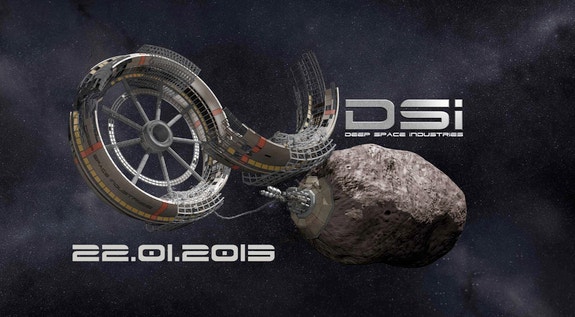
Asteroid Mining
I have been debating what science thing to post today. There are so many good offerings: labor pain simulators for men, using PET scans to detect brain damage in football players before they know anything is wrong. I think that I will go with space-themed: asteroid mining.
What is it you ask? Well it's mining... In space!
Why? Aren't there mines here on Earth? Well, yes, but there are three reasons why mining asteroids makes sense:
What is it you ask? Well it's mining... In space!
Why? Aren't there mines here on Earth? Well, yes, but there are three reasons why mining asteroids makes sense:
- No need to launch materials into space. It costs a lot of money to get materials out of Earth's gravity. These are already "out there".
- Many asteroids contain metals that are relatively rare on Earth.
- Many asteroids contain water which would be an indispensable commodity to space explorers.
Two major groups working on plans at the moment are:
Friday, January 18, 2013
Real Life Mario Kart
RFID tags can make possible a number of things such as tagging animals, managing product inventories, or tracking railroad cars. Now a group from Austin has used this technology to allow Mario-style go cart racing. You should really watch the video, but a few things that you will see: banana peels that cause cars to spin out of control, mushrooms that increase your speed, and shells that can be fired at other carts.
Check out some of the other cool things that Waterloo Labs has built.
Check out some of the other cool things that Waterloo Labs has built.
Wednesday, January 16, 2013
Ancient Words
Okay, this one is not directly related to any science that I teach, but I have been thinking about it recently. Cdza (an experimental music group) has come out with a video where they put the lyrics to the "Fresh Prince" theme song through Google Translate and then back to English. It's pretty amusing.
One thing that caught my eye (ear?) is that some words stayed the same even at the end. Not many, but "mama" and "home" were still there. Why is this interesting? Well, these words were easy enough for a computer to translate that they must be pretty basic in a number of languages. They are also fairly basic words. Could it be that these are some of the oldest words in the world? What other words might be as ancient?
One thing that caught my eye (ear?) is that some words stayed the same even at the end. Not many, but "mama" and "home" were still there. Why is this interesting? Well, these words were easy enough for a computer to translate that they must be pretty basic in a number of languages. They are also fairly basic words. Could it be that these are some of the oldest words in the world? What other words might be as ancient?
Tuesday, January 15, 2013
CK-12
Free online textbooks, study guides, online quizzes, SAT prep, etc. I love this site.
Highly Recommended.
http://www.ck12.org/student/

Highly Recommended.
http://www.ck12.org/student/

Monday, January 14, 2013
White House Says "No" to Death Star
So, the White House has a program called We the People. Basically, if can make a request and if 25,000 people sign it (online) the government will respond. Last year, some people posted the following:

Those who sign here petition the United States government to secure funding and resources, and begin construction on a Death Star by 2016.
By focusing our defense resources into a space-superiority platform and weapon system such as a Death Star, the government can spur job creation in the fields of construction, engineering, space exploration, and more, and strengthen our national defense.

The petition got almost 35,000 signatures, so a response was granted. Rather than reprinting it, you should read the answer.
Friday, January 11, 2013
Rare Earth Metals
Yttrium, neodymium, gadolinium. Heard of them? It's not too surprising if you haven't. They are metals. Specifically, they're rare earth metals. As it sounds, there's not a lot of them. In addition, most of the world's supply is in the hands of one country.
Why should we care? Modern electronics rely on these metals. Having a stable supply is more critical now then ever before. The Department of Energy has set up a new program to help make these into less rare earth metals. The approach has 3 parts: find new sources, replace current materials with more common ones, and recycle old electronic components. Sounds like a solid idea.

Source: http://www.popsci.com/science/article/2013-01/new-120-million-department-energy-center-will-tackle-rare-earths-shortage
Thursday, January 10, 2013
Exoplanets
I can't help but marvel at the incredible number of planets outside our own solar system (exoplanets) that are being discovered. Over 2,000 have been found since the late 1990s, although some are still awaiting confirmation. Some of these may be Earth like with water. Many scientists believe (although I am more skeptical based on lack of available evidence) that where there is water there is life.
Even if liquid water is very rare on other planets, consider the numbers. Recent calculations suggest that there may be around 100 billion planets in the galaxy. 100 billion! Add to that the fact that there are estimated to be 100 billion galaxies in the universe. Imagine the possibilities. There's more than enough room for a few alien lifeforms to be tucked into a some solar systems around somewhere.

Even if liquid water is very rare on other planets, consider the numbers. Recent calculations suggest that there may be around 100 billion planets in the galaxy. 100 billion! Add to that the fact that there are estimated to be 100 billion galaxies in the universe. Imagine the possibilities. There's more than enough room for a few alien lifeforms to be tucked into a some solar systems around somewhere.

Wednesday, January 9, 2013
Want to go to Mars?
One of the most exciting advances of the previous year has been the growth of private spaceflight. Now, a group in the Netherlands claims that they want to get people to Mars by 2022 (well ahead of any government plans). They plan to pay for it by shooting a reality show. On Mars!
Want to go? They are about to start taking applications. You must be 18 to apply.
One word of warning before you get too excited. It's a one way trip. If this mission gets off the ground (pun intended), you will spend the rest of your life on the Red Planet.
One word of warning before you get too excited. It's a one way trip. If this mission gets off the ground (pun intended), you will spend the rest of your life on the Red Planet.
Tuesday, January 8, 2013
Round 2 Announcements
Welcome back everyone. Below you will find the notes on class procedure and citizen science that we looked at in class.
Don't forget to log your time for extra credit.
Monday, January 7, 2013
Can you know too much?
With DNA analysis techniques becoming ever cheaper, personalized medicine is poised to start impacting our lives in a major way.
Companies such as 23andMe can offer a genome analysis for as low as $99. This is by no means a complete DNA sequencing, but offers a wealth of information. Would you like to know your genetic ancestors? Your risk of passing sickle cell anemia on to your children? How about how different medical drugs will affect your body?
Too much information is not always a good thing. These tests can also tell you your risk of developing Alzheimer's. Would you want to know if you had an 80% chance of contracting Alzheimer's? There is currently no cure and few treatments. Would it be better to just find out when it happens and not have to worry for years that it might happen? These are decisions that we will have to make in the coming years.

Sunday, January 6, 2013
Top Science Breakthroughs of 2012
Take a look at this list from Wired. It outlines the 10 "most important" breakthroughs in science in 2012.
How many have you heard of before this? Are there any that should have made the list, but did not?
My personal choice is the SpaceX launch. With government funding for spaceflight on the decline, privatization of space travel seems to be an attractive option. I'm still holding out for a space elevator though.

Subscribe to:
Posts (Atom)